A mental arithmetic game

Count it up
in your head.

A problem appears. You work it out yourself and type the answer. The round ends when the clock does. Your score is how many you finished — no hints, no multiple choice, no calculator.

  • Add, subtract, multiply, divide
  • Six modes
  • 30, 60, or 120 seconds
  • Whole-number answers
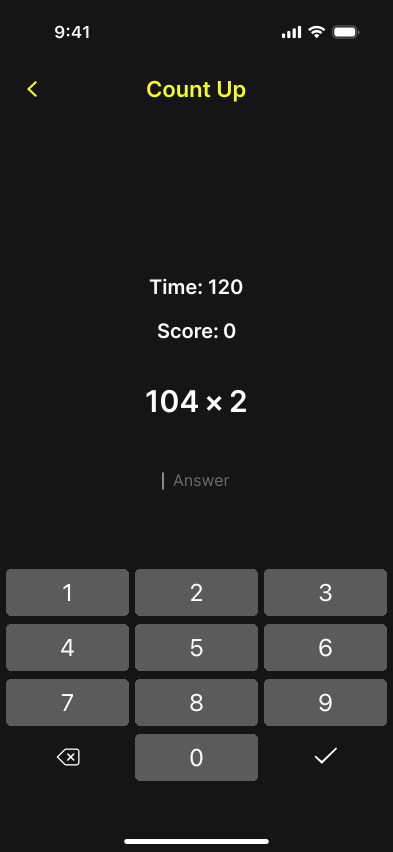
Count Up in a round: 120 seconds left, score 0, the problem 104 times 2, and a keypad.
One problem. A keypad. A clock.

The mechanic

A round is a stack of problems and a clock.

Count Up is the old drill of doing arithmetic in your head, with a score at the end. You pick a mode, press Start Game, and problems arrive one at a time. You type the answer and confirm it. Then the next one is already there.

  1. Pick a mode

    Game Options sets the clock and the size of the numbers. Settings spells out exactly what each mode contains.

  2. Produce the answer

    The keypad is digits, a backspace, and a check. There is no decimal point and no minus key, so every answer is a whole number you can type. Division problems come out even.

  3. Stop when the time does

    Rounds last 30, 60, or 120 seconds. The score is how many problems you solved. The home screen keeps that round, with a rate and the date, in Previous Games.

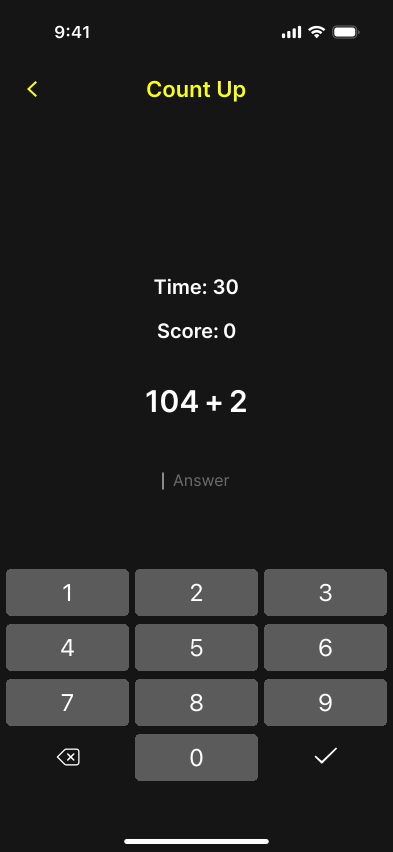
A 30-second round showing the addition problem 104 + 2 and an empty answer field.
Hyper gives you 30 seconds.

All four operations

The sample on screen is simple. The mode decides how large the numbers get.

Addition problem, 104 + 2, during a 30-second round.
Addition
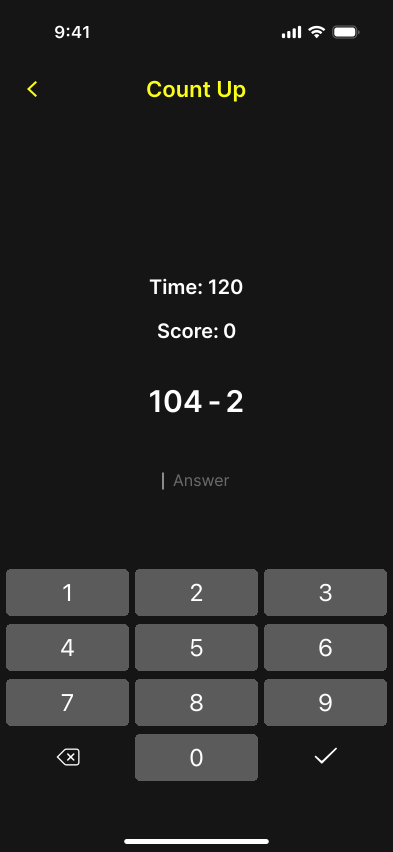
Subtraction problem, 104 − 2, during a 120-second round.
Subtraction
Multiplication problem, 104 × 2, during a 120-second round.
Multiplication
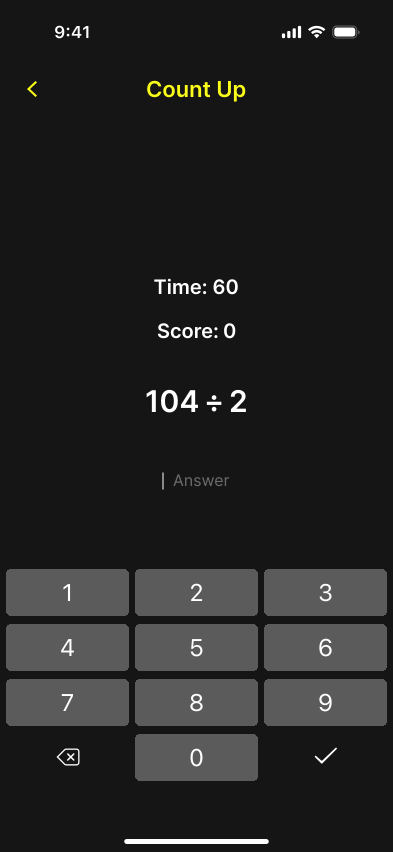
Division problem, 104 ÷ 2, during a 60-second round.
Division

Six ways to set the load

Same four operations. Different numbers, different clocks.

Every mode mixes addition, subtraction, multiplication, and division. Easy and Fast currently share the same ranges and the same two-minute clock. Easy Fast keeps those ranges and cuts the time in half. Hyper uses the Normal ranges in 30 seconds.

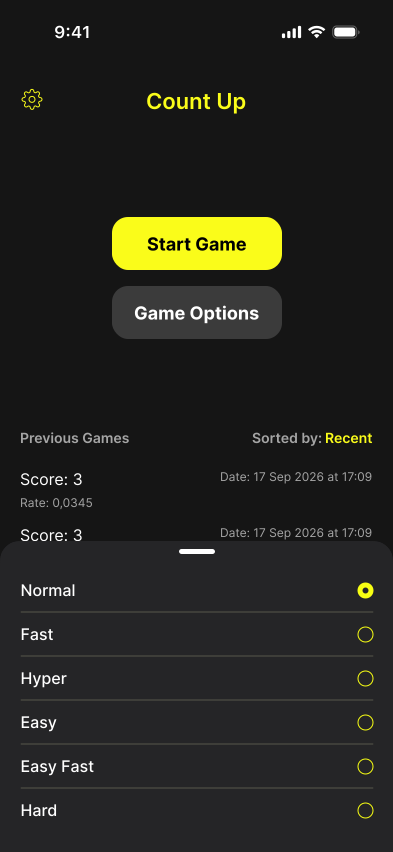
The mode list: Normal selected, then Fast, Hyper, Easy, Easy Fast, and Hard.
Choose before the clock starts.
  1. 120sec

    Easy

    Small sums and the one-digit times tables. A full two minutes to find a rhythm.

    Add / subtract
    (1–20) ± (1–20)
    Multiply / divide
    (1–9) × ÷ (1–9)
  2. 120sec

    Fast

    The same compact ranges and the same clock as Easy — a second door into the small numbers, once they feel familiar.

    Add / subtract
    (1–20) ± (1–20)
    Multiply / divide
    (1–9) × ÷ (1–9)
  3. 60sec

    Easy Fast

    Those same small problems, with half the time. Pace becomes the point.

    Add / subtract
    (1–20) ± (1–20)
    Multiply / divide
    (1–9) × ÷ (1–9)
  4. 120sec

    Normal

    The everyday round. Multiplication and division stay anchored to a factor from 2 to 12, so you are retrieving a times table against a larger number — 8 × 76, or 96 ÷ 12 — not inventing 47 × 83.

    Add / subtract
    (2–100) ± (2–100)
    Multiply / divide
    (2–12) × ÷ (2–100)
  5. 30sec

    Hyper

    Normal’s number ranges, squeezed into half a minute. There is no time to stall on a carry.

    Add / subtract
    (2–100) ± (2–100)
    Multiply / divide
    (2–12) × ÷ (2–100)
  6. 120sec

    Hard

    Three-digit addition and subtraction, and multiplication or division where both numbers sit between 5 and 30. This is the mode that asks you to hold a partial result in mind.

    Add / subtract
    (10–1000) ± (10–1000)
    Multiply / divide
    (5–30) × ÷ (5–30)
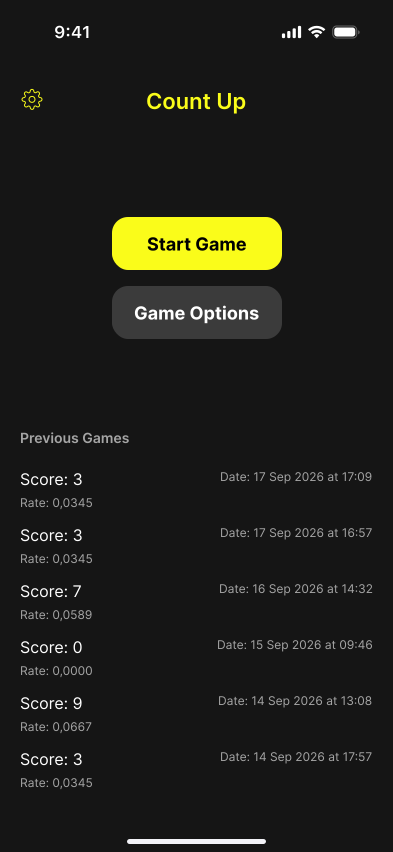
The Count Up home screen: Start Game, Game Options, and previous games with scores, rates, and dates.
Previous games stay on the phone.

The record

A score you can compare to last Tuesday.

When the round ends, it lands in Previous Games: a score, a rate, and a date. Score is how many problems you solved. Rate is the pace figure kept beside it, so a lucky round and a fast round do not look the same.

The list is sorted with the newest first. There is no account to create and no board of strangers to chase. The person you are trying to beat is you, on a slightly worse day.

Why this is good for your brain

It practices the part a calculator skips.

Mental arithmetic is a specific skill: holding numbers, choosing an operation, and producing an answer before the next problem arrives. Count Up is built around that loop, and almost nothing else.

01

You generate the answer

Multiple choice lets you recognize a result that is already on the screen. Count Up does not offer one. You have to retrieve the fact or compute it, then commit. That production — not the glance at a finished sum — is what later makes 8 × 7 feel immediate.

02

The clock gives attention a container

A round is 30, 60, or 120 seconds. Long enough to warm up, short enough to finish on a platform or between meetings. You stay inside the problem because the next one is waiting and the timer is not sentimental.

03

The difficulty is a real dial

One-digit times tables and 640 + 875 are not the same task. Easy lets the facts settle. Normal asks you to carry and to scale a times table. Hard asks you to keep a partial product in working memory. You can sit at the edge of what you can do, which is where practice actually changes the skill.

04

The only progress is your own list

Previous Games is a plain record: score, rate, date. A better week shows up as a better line, not as a badge. That is a useful kind of feedback. You notice whether you are getting quicker at the thing you practiced.

What the research supports

Solving it yourself is the ingredient.

The studies below are about arithmetic and memory, not about this app. They explain why the mechanic is worth your two minutes — and where the claims should stop.

01

Producing an answer beats looking at one

The testing effect is one of the sturdier findings in learning research: trying to recall something strengthens it more than studying it again. A round of Count Up is retrieval, over and over. You do not review a worked solution. You supply the result, get the next problem, and supply another. A calculator finishes the chore and skips that retrieval. The practice is the retrieval.

Roediger, H. L., & Karpicke, J. D. (2006). Test-enhanced learning: Taking memory tests improves long-term retention. Psychological Science, 17(3), 249–255. Risko, E. F., & Gilbert, S. J. (2016). Cognitive offloading. Trends in Cognitive Sciences, 20(9), 676–688.

02

Practice changes how the brain does the problem

Early on, a less familiar sum leans on working memory and step-by-step calculation, with heavy use of frontal and parietal regions. With practice, many problems shift toward direct retrieval of the answer. Imaging studies of multiplication and subtraction training show that shift: the brain does less slow computing and more fact retrieval for the operations you actually trained. The gain is specific. Getting faster at 7 × 8 does not, by itself, make you faster at unrelated thinking.

Ischebeck, A., Zamarian, L., Siedentopf, C., et al. (2006). How specifically do we learn? Imaging the learning of multiplication and subtraction. NeuroImage, 30(4), 1365–1375. Zamarian, L., Ischebeck, A., & Delazer, M. (2009). Neuroscience of learning arithmetic — Evidence from brain imaging studies. Neuroscience & Biobehavioral Reviews, 33(6), 909–925.

03

Arithmetic uses a known network, and effort is part of it

A meta-analysis of brain-imaging studies puts number magnitude and calculation in a network centered on the parietal lobe — especially the intraparietal sulcus — with prefrontal areas recruited when the problem needs working memory, planning, or a strategy. Harder problems, and problems you have not automated, ask more of that system. That is the honest version of “this works your brain”: it works the systems arithmetic uses, at a load you chose.

Arsalidou, M., & Taylor, M. J. (2011). Is 2+2=4? Meta-analyses of brain areas needed for numbers and calculations. NeuroImage, 54(3), 2382–2393. Bjork, E. L., & Bjork, R. A. (2011). Making things hard on yourself, but in a good way: Creating desirable difficulties to enhance learning. In M. A. Gernsbacher et al. (Eds.), Psychology and the real world.

Count Up trains mental arithmetic: speed and accuracy on problems like the ones in the round. It is not a medical device, and it is not an IQ program. Broad “brain training” claims — better grades, a younger brain age, protection from dementia — are not what this research shows. A careful review of commercial brain-training programs found that people improve on the tasks they practice, and that far transfer to everyday cognition is weak or unproven. Play it because you want to be quicker and more accurate at arithmetic.

Simons, D. J., Boot, W. R., Charness, N., Gathercole, S. E., Chabris, C. F., Hambrick, D. Z., & Stine-Morrow, E. A. L. (2016). Do “brain-training” programs work? Psychological Science in the Public Interest, 17(3), 103–186.

Voices

What a round feels like.

Sample testimonials written for this page. Replace them with real player quotes before you publish.

“I stopped handing tips and split bills to my phone. A week of Normal and the carrying just happens.”

Jordan Illustrative quote · office manager

“Hyper is thirty seconds of not being allowed to stall. I open it before I sit down to study.”

Priya Illustrative quote · student

“Easy Fast fits between two stations. It is the rare phone game that leaves me sharper when I lock the screen.”

Sam Illustrative quote · teacher

Questions

Before the first round.

What happens in a round?

You choose a mode, start, and solve problems until the clock runs out. Each problem is one operation. You type a whole number and confirm it. The next problem replaces it. At the end, the round is saved with a score, a rate, and the date.

What is the score, and what is the rate?

Score is how many problems you solved in the round. Rate is the pace figure the home screen stores next to that score. Use the two together: a high score on Easy and a high score on Hard are not the same kind of day, and the rate is there so pace is visible, not just a feeling.

Where should I start?

Easy, if the times tables are rusty: numbers from 1 to 20 for sums, and 1 to 9 for multiplication and division, for two minutes. Move to Normal when two-digit addition feels ordinary. Use Hyper when you want Normal’s numbers and almost no time to hesitate. Hard is for people who want three-digit sums and products like 18 × 24.

Will this make me smarter?

It will give you practice at mental arithmetic, which is a real skill you can feel in ordinary calculations. It will not raise your IQ by a promised amount, and it is not a treatment. The science section is specific about what the research supports.

Do I need an account?

The app as it stands does not ask you to sign in. Previous games stay on the device. See the privacy policy for how that is described.

Who is it for?

Anyone who can do the arithmetic in the mode they pick. Easy is times tables and small sums. Hard is much heavier. It is a focused drill, not a cartoon for small children and not a school curriculum.

One round

Put the calculator back in your pocket.

Two minutes, or thirty seconds if you are in a hurry. Solve what you can. Look at the list tomorrow and see if the rate moved.

Yellow 7, minus, plus, and multiplication signs on black.